
When Grandfather Met the Queen
It was going to be a busy day at the office. He was about to meet the Queen.
A busy day at the office
My paternal grandfather, Walter Parker, woke up that morning, the 12th of January 1954, got his wig off the hatstand, said hi to my father Graeme, who was ten at the time, kissed his wife Gertrude goodbye, and caught the train into work.
It was going to be a busy day.
He was about to meet the Queen.
Well. Sort of. More on that later.
I never knew Walter. He died when I was about one. Everything I know about him comes from family stories, a handful of photos, a jar on the mantelpiece, and a handful of old photos.
Those photos, as it turns out, tell us a lot about the man.
A first for New Zealand
In January 1954 Queen Elizabeth II was touring New Zealand. She was the first reigning monarch to ever set foot here, and on the 12th she did something no monarch had ever done before. She opened the New Zealand Parliament in person.[1]
It was Parliament's centennial year. The Queen was 27. She had been crowned only seven months earlier, and for the occasion she wore her coronation gown. Wellington was in the grip of monarchy fever.
And at the front of it all, or at least at the front of one important part of it, was my grandfather.
Walter was the Sheriff of the Supreme Court in Wellington (the court we now call the High Court). The judges don't have a formal role at the opening of Parliament, but by long tradition they attend, and it is the Sheriff's job to escort them there and back.[2]
So that's what Walter did. He led the judges of New Zealand, in full wigs and robes, in procession to Parliament.
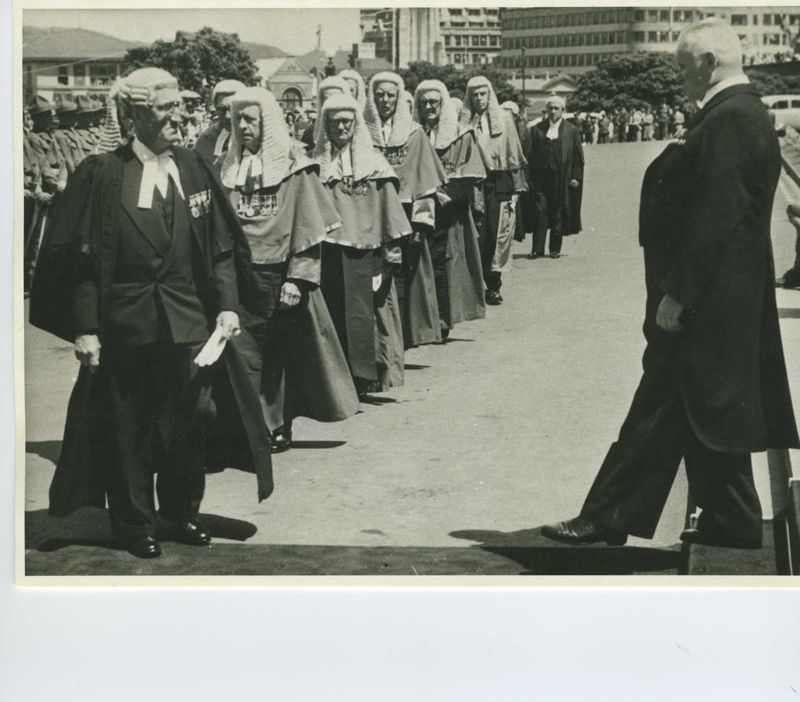
Wig, black gown, bands, a row of medals on his chest, and a long line of Her Majesty's judges falling in behind him like ducklings. Soldiers lining the route. Crowds behind them. Not a flicker of nerves on his face. Stoic as.
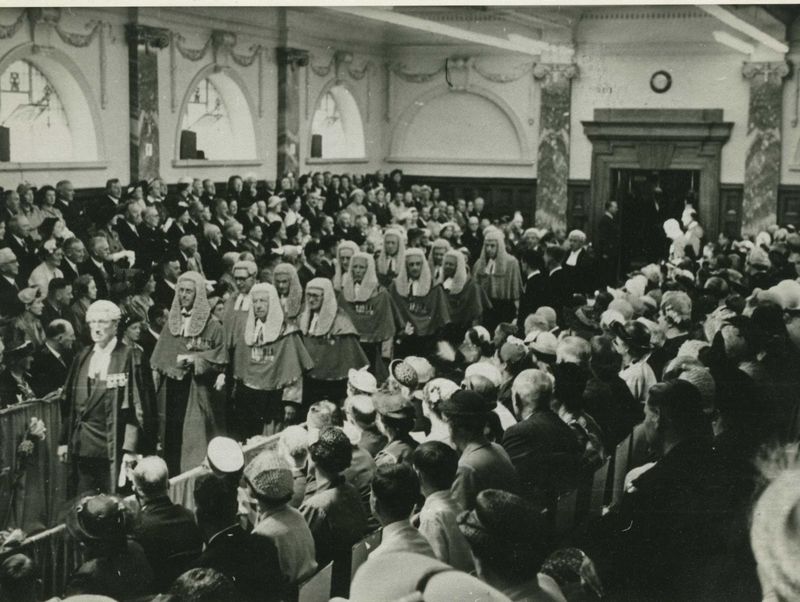
Then inside. The hall is packed to the rafters, everyone in their best hats, and there's Walter, still out in front, far left, leading the judges through the crowd to their seats. Remaining composed.
The crowning glory
Walter isn't in this next photo. But this is the moment all that marching was for.
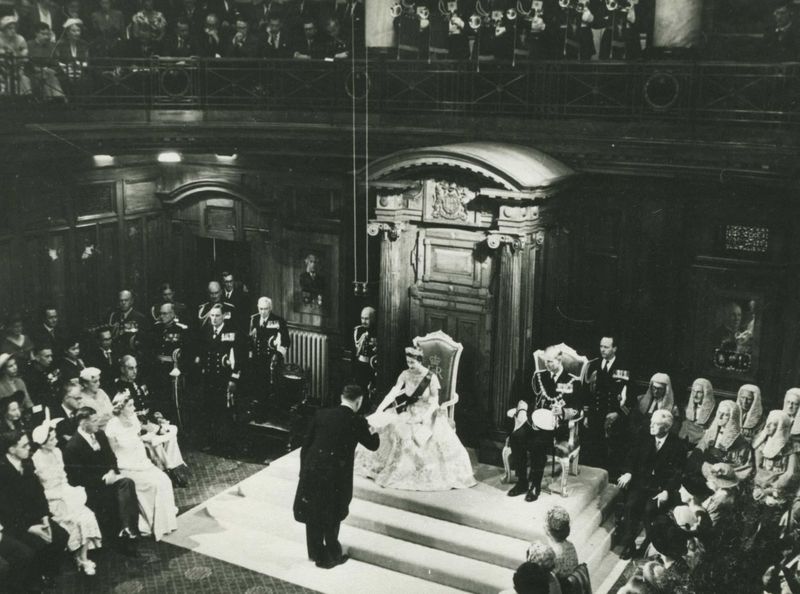
That's Queen Elizabeth II, on the throne in the Legislative Council Chamber, in her coronation gown. Prime Minister Sidney Holland is bowing at the foot of the steps, handing her a vellum copy of the Speech from the Throne, which she is about to read to formally open Parliament. Prince Philip sits beside her in full naval uniform.
And over on the right, in their wigs, the judges. The ones Walter just delivered. I can't see him in this photo but i imagine he is just off to the right of frame.
So did Walter meet the Queen? I can't honestly say he shook her hand. I don't recall any family stories about that. But he was in the room, a few metres away, with a front row seat to history, and he got there by leading the procession. He wasn't known for his chat and it predates the age of selfies, but who knows?
No one can say for sure that he didn't. That'll do me.
Thank you, your Honour
So what sort of man was he, judging from the few sources I could find?
The best answer I have comes from the New Zealand Law Journal of 6 November 1956, page 317, which reported on his retirement.[3] By then his full title was Registrar of the Court of Appeal and of the Supreme Court, as well as Sheriff, in Wellington.
The local lawyers threw him a farewell and presented him with a silver tea and coffee service and a cheque. The President of the Wellington District Law Society opened by admitting he'd had some trouble getting Walter to turn up at all. Apparently Walter was appalled at the idea of having to stand up in front of everyone.
The President went on to say that, if there was one thing nobody could accuse Walter of, it was talking too much. He said that in the "six years and a bit" Walter had been Sheriff and Registrar in Wellington, he'd done the job quietly, and efficiently.
Then Walter got up to reply. He said he'd spent the previous night making notes on what to say, and then:
"I might as well have gone out and gazed at the stars"
He couldn't remember a word of them. I love that.
He went on to thank the lawyers who'd helped him along the way, starting from when he was a very green cadet clerk in Dunedin. He told them it was no easy day, standing there at the end of the road. And then he gave most of the credit to his staff.
It's the only place I've heard his voice. Thanks, NZ Law Journal. Amazing what you can find on the internet.
Before the wig
Walter was born on the 13th of September 1896, at Stirling in South Otago. He grew up in Southland, where his father Benjamin farmed around Brydone and Ota Creek, specks on the map near Gore, in the south of New Zealand's South Island. He went to Brydone School, then Gore High School.
Around 1912, still a teenager, he joined the Civil Service as a cadet in the Advances to Settlers' Office in Wellington, then transferred to the Supreme Court, and started what would turn into a forty-odd year tour of New Zealand's courthouses. Dunedin. Christchurch. Auckland, where during the First World War, still a cadet, he found himself doing the work of a clerk who'd gone off to fight.
Then he went off to fight himself.
In October 1916, aged 20, Walter enlisted. His Army papers[4] list him as a clerk for the NZ Government, living at the YMCA in Akaroa, next of kin Benjamin Parker, Brydone. He was posted to G Company of the 22nd Reinforcements, sailed for Europe in February 1917, and in June joined D Company, 3rd Battalion, 3rd New Zealand Rifle Brigade. Rifleman Parker, number 39090.
The New Zealanders had just taken Messines. By August they were holding the line near Warneton, just south of Ypres, in Belgium, as the Third Battle of Ypres got underway around them.
On the 8th of August 1917, Walter was hit.
The cables that went home record a gunshot wound to the left shoulder, fractured shoulder blade, "severe". He went through a Canadian hospital in Rouen, then on to the New Zealand hospital at Brockenhurst in England. He was put on a ship home, the Marama, from Avonmouth in November 1917, and was back in New Zealand in time for the new year.
News travelled slowly. Three weeks after he was hit, the Southland Times told the folks back home.[5]

A scholar and an athlete, apparently. A "nippy" half-back for the Gore High 2nd fifteen, and a quarter-mile runner "of more than average calibre". That's not the Walter I'd pictured from the photos. I'd pictured the man in the wig. Here he is at 20, a quick little half-back from Gore, lying in a hospital in France.
In August 1918 the Army discharged him as "no longer physically fit for War Service on account of wounds received in Action". British War Medal. Victory Medal. You can see them, I think, among the row on his chest in the 1954 photos.
Now, here's the thing. The family story has always been that Walter took shrapnel in the stomach at Ypres. The shrapnel itself sits in a little container on the mantelpiece, has done for as long as I can remember. The Army says shoulder. The family says stomach. Perhaps it was both. Perhaps the Army clerks didn't get it all down. Perhaps that's just how family stories go.
What I know for sure is that he was 20, a long way from Southland, and he was lucky to come home at all. Plenty from his battalion didn't. From time to time I show people the lump of shrapnel. I wouldn't want that dug out of me.
Gertrude
Walter went straight back to clerking. In April 1920 the Government Gazette appointed him Clerk of the Magistrate's Court at Riverton, along with Clerk of the Warden's Court, Receiver of Gold Revenue, and Mining Registrar.[6] That's a lot of titles for a 23 year old in a small Southland town. By 1921, his war medal paperwork had followed him to the courthouse at Naseby, in Central Otago.
Somewhere in among all that, he met Gertrude Limbrick.
The Limbricks were a Waipawa family, in Central Hawke's Bay, and in Waipawa they were something of a big deal.
Gertrude's father, Harry Limbrick, ran the Dominion Livery and Bait Stables. Gigs, buggies, waggonettes and saddle horses for hire, a well appointed hearse, and "Up-to-date Turn-outs for Weddings, Picnics, etc." In the days before everyone had a motor car, Harry met every train with his hackney carriage with "clockwork regularity", and the local paper reckoned it was one of the institutions of old Waipawa.[7]
Harry's big brother, William Isaac Limbrick, ran the town. When Waipawa became a borough in 1908, William was elected its first mayor, and he held the job for 13 years. In his first year he raised £21,100 in loans for sewerage, gasworks, water and borough buildings, and he went on to build the Municipal Theatre and secure Coronation Park. He retired to Plimmerton in 1921, couldn't stay away, and in 1928 came back to finish the term after the sitting mayor was killed in an accident.[8]
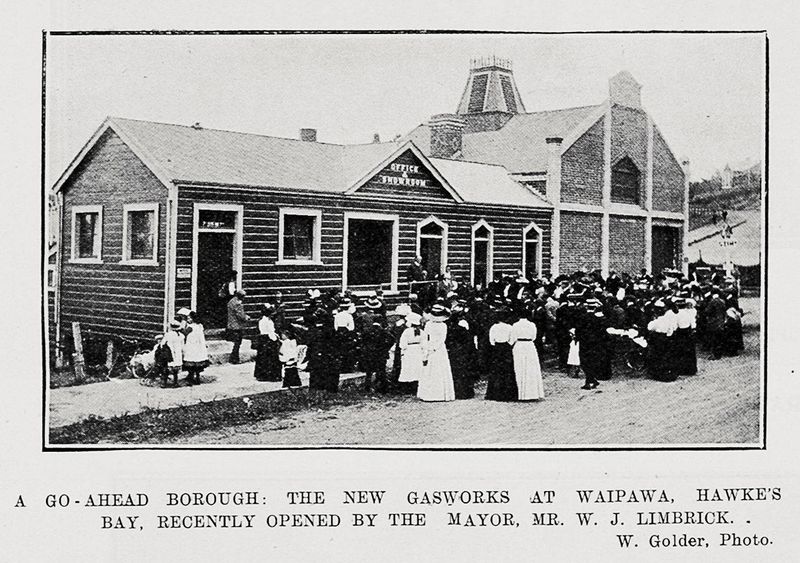
That's his new gasworks, with half the town out in their Sunday best for the opening.[9] Limbrick Street, on the hill to the west of the main road, is named after him, and it's still there on the Waipawa heritage walk map today.[10]
Walter and Gertrude were married at St Peter's Church in Waipawa, around New Year 1925. Gertrude Adelia was Harry's elder daughter, and he gave her away. Walter's sister Jean and Gertrude's sister Rita were the bridesmaids, and Gertrude's brother was best man. Afterwards the happy couple "left by motor on their honeymoon trip". I like to think Harry supplied the car.[11]
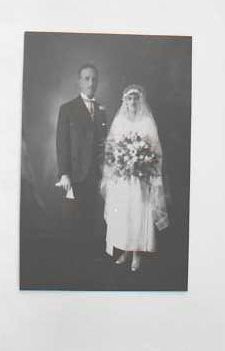
That's them on their wedding day. Gertrude with an armful of flowers and a veil to the floor, Walter looking every bit as serious as he does thirty years later in the wig. I hope he said something at the reception!
A courthouse in every town
From there Walter and Gertrude moved, and moved, and moved again. That's the life of a court clerk. Wherever there was a courthouse, the Department needed someone to run it.
By 1932 they were in Christchurch.[7:1] In 1939 they were in Nelson, where the Gazette made Walter the Registrar of the Supreme Court and Sheriff for the District of Nelson. Plus, because it was Nelson and someone had to, Clerk of the Magistrate's Court, Clerk of the Warden's Court, Mining Registrar for the Karamea mining district, Official Assignee in bankruptcy, Clerk to the Licensing Committee, Local Patent Officer, and Marshal of the Supreme Court for its admiralty jurisdiction.[12]
I'd love to have seen his business card.
Called up again
In August 1940, with the Second World War underway, Walter signed up again, this time for the National Reserve in Nelson. He was 44, a Clerk of Court, 5 foot 8 and a half, fair hair, blue eyes, living at 21 Brook Street. Previous military service: "N.Z.E.F. - 1½ years."[4:1]
On the 11th of December 1941, four days after Pearl Harbor, he was mobilised.
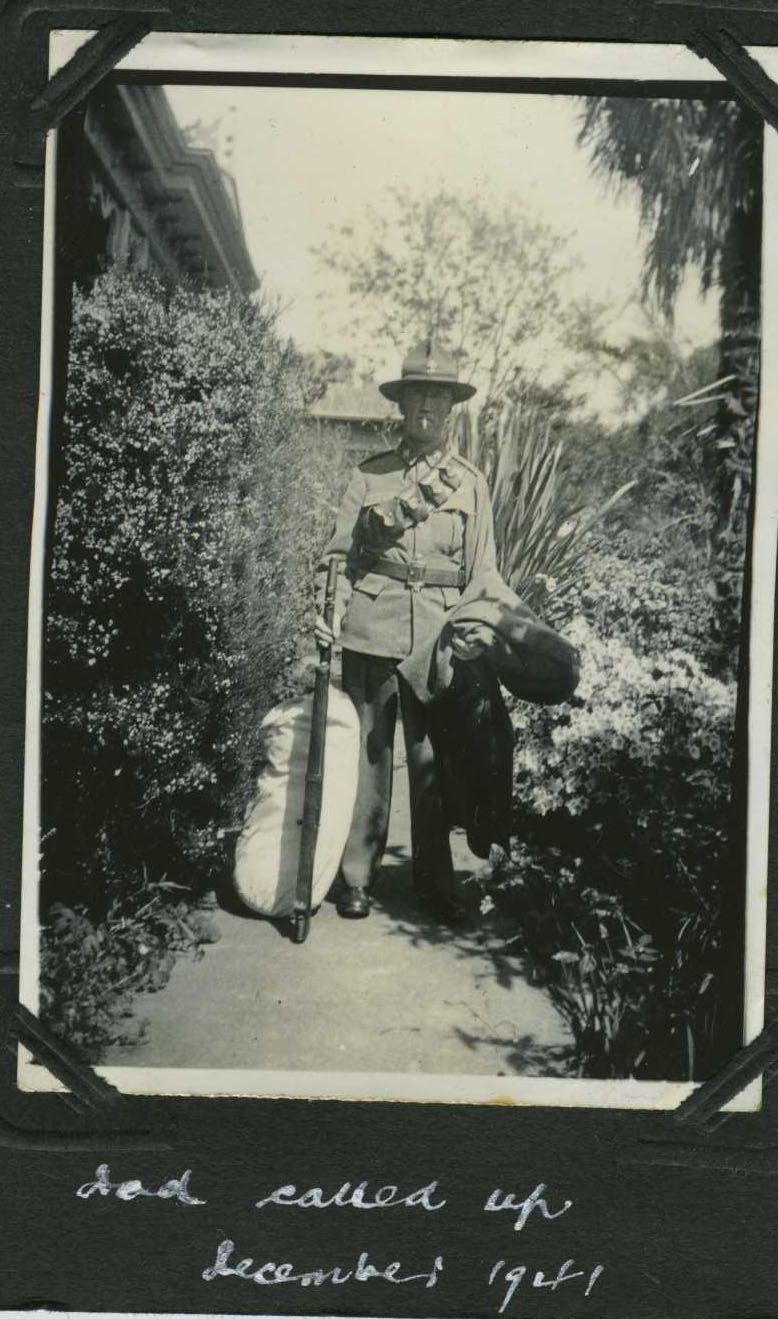
That's him, heading off. Lemon squeezer hat, rifle, kitbag, a cigarette, and a greatcoat over his arm in the summer sunshine. Someone in the family wrote "Dad called up December 1941" in white ink under the photo.
He was no longer a rifleman this time round. Over the next few months he did a rifle course at Riccarton, officer training at Burnham, and came out a sergeant.
Back in civilian life, the moves kept coming. The family was in Wanganui by 1943, the year my father Graeme was born, and Walter's Army file lists his address as the Courthouse, Wanganui. In March 1947 he went back to Christchurch as Registrar of the Supreme Court and Sheriff for the District of Canterbury.[13]
And then, around 1950, Wellington. The top job.
Six years and a bit
Those were busy years to be running the capital's court. The death penalty had just been brought back. The 1951 waterfront dispute was tearing the country in two. And in the middle of it all, a quiet man from Southland kept the machinery of the Supreme Court and the Court of Appeal turning over, swore in juries, signed the notices, and once, in January 1954, put on a wig and led the judges in to see the Queen.
Walter retired in late 1956, around his sixtieth birthday. Six years and a bit. Silver tea and coffee service. A cheque in an envelope. An audience he would rather not have had to face.
He died almost twenty years later, when I was about one.
Gazing at the stars
I've spent a little time with Walter lately. Reading his Army forms. Squinting at his handwriting on medal receipts. Reading a speech he gave seventy years ago, about not knowing what to say.
He was wounded at Ypres, married a girl from Waipawa, moved from courthouse to courthouse for forty years, and raised a family, including my father. He was called up for two world wars. He had his moment in front of the Queen, and by all accounts he'd have hated anyone making a fuss about it.
Sorry Walter. I'm making a fuss.
I wish I'd known you, but learning a little about your life 50 years after your passing is the next best thing. And now I get to tell people my grandfather met the queen! Because, well... maybe you did... and I bet you didn't say much.
On this day in 1954: Queen Elizabeth II opens New Zealand Parliament, NZ Parliament ↩︎
Opening of Parliament, Courts of New Zealand ↩︎
Presentation to Mr Walter Parker, New Zealand Law Journal, 6 November 1956, p.317 (PDF, 3.4MB). Originally published by Victoria University of Wellington Library ↩︎
Walter's WW1 and WW2 military personnel files (PDF, 3.3MB), Archives New Zealand ↩︎ ↩︎
Southland Times, 28 August 1917, Papers Past ↩︎
Obituary, Mr H. D. Limbrick, Waipawa Mail, 16 December 1932, and Dominion Livery advertisement, Waipawa Mail, 8 October 1924, Papers Past ↩︎ ↩︎
A Notable Figure: Death of Mr W. I. Limbrick, Waipawa Mail, 9 October 1940, and Death of Waipawa Citizen, Hawke's Bay Herald-Tribune, 8 October 1940, Papers Past ↩︎
A Go-Ahead Borough, Auckland Weekly News, 17 November 1910, photo by W. Golder. Auckland Libraries Heritage Collections, no known copyright restrictions ↩︎
Waipawa Pavement Walk (PDF, 2.6MB). Originally published by Hawke's Bay Tourism ↩︎
Waipawa News: A Popular Wedding, Hawke's Bay Tribune, 3 January 1925, and Parker–Limbrick, Southland Times, 24 January 1925, Papers Past ↩︎